Tracer gas leak detection fills a pipe with a gas that is lighter than air and detectable at very low concentrations, then uses a sensor to find where it escapes. Helium is one such gas. Another common choice is a mix of hydrogen and nitrogen sold as forming gas.
It works because the gas molecules are tiny and travel through very small openings. A sensor held above the floor or ground picks up the gas where it reaches the surface. It is a good way to find a leak in a buried line or under a slab without digging.
Most residential water leaks are found with other methods first. This guide explains how tracer gas works, when it makes sense and what a plumber uses in the meantime.
Methods for finding a hidden leak
Each method answers a different question.
| Method | What it finds | Limits |
|---|---|---|
| Water meter test | Whether any leak exists on the property | Does not say where |
| Acoustic listening | The sound of pressurized water escaping | Background noise and pipe material affect it |
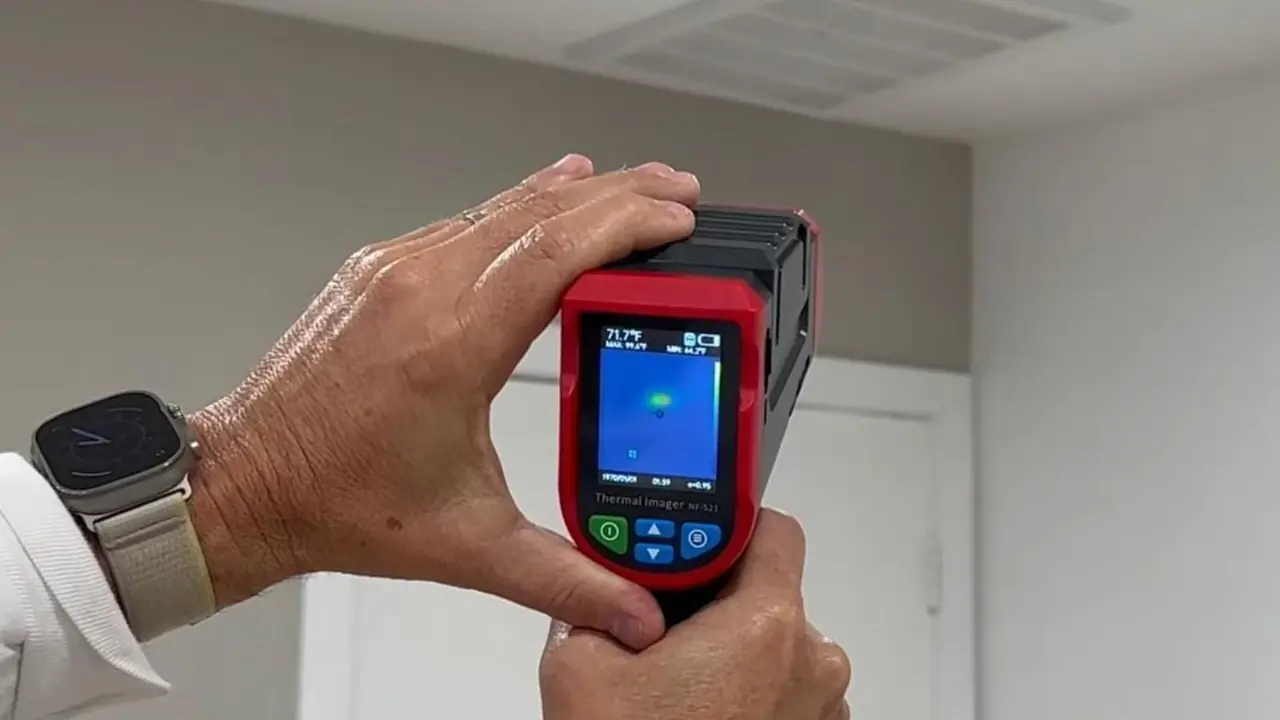
| Thermal imaging | Temperature differences from hot water leaks or wet materials | Works best when the leak changes surface temperature |
| Pressure test | Whether a section holds pressure | Isolates a section, does not find the exact spot |
| Tracer gas (helium or forming gas) | Pinpoints the gas path to the surface | Needs the line drained and filled with gas, and specialty equipment |
When tracer gas makes sense
Tracer gas is a specialist tool. It is useful when acoustic listening cannot find the spot, such as a leak in a buried line with a lot of background noise, or a leak under a thick slab. It is also used on large commercial systems and on pipes that are not under water pressure.
The process requires draining the section, filling it with gas, and walking the area with a detector. It adds cost and setup time, so it is used when simpler methods have run out.
Not every plumber carries the equipment. We use acoustic, thermal and pressure methods on residential leaks, and we tell you if a case needs a specialist with tracer gas. See leak detection for how we search.
What most house leaks need
Most house leaks start with a meter check. Turn everything off and see whether the meter moves. If it does, there is a leak. Then isolate sections with valves to narrow the area. If the leak is inside the house, thermal imaging and a moisture meter often find it. If it is buried, acoustic listening at the curb stop and along the line finds it.
Many leaks turn out to be at a fixture, such as a toilet flapper or a faucet, not in a buried pipe. We check those first because they are the cheapest to fix. A dye test in the toilet tank takes minutes.
If the leak is a failed supply line, a repair at the spot is often enough. See water line repair for lines from the street.
Questions to ask before you pay for a specialty method
Ask what the method will find that simpler tools cannot. Ask whether the plumber has already done a meter test and an isolation test, since those are cheap and narrow the search. Ask what happens if the gas test finds nothing.
A good answer is specific. A vague answer that the gas finds everything should make you cautious. Every method has limits, and the honest ones tell you what they are.
What to do while you wait for a plumber
Shut off the main water valve if you see water, and note the meter reading so you can see how fast it moves. Take photos of any stains or damp spots with a date. Check fixtures that could be the source, such as toilets that run on and sink supply lines.
If your water heater or washing machine is nearby, check those hoses and connections. A surprising number of hidden leaks turn out to be a simple connection that is easy to reach.
What a repair looks like once the leak is found
Most repairs are small. A section of pipe is cut out and replaced, a fitting is tightened or replaced, or a valve is swapped. The cost is usually modest next to the cost of the search.
If the pipe is old and has several weak spots, the conversation moves to replacement of a section or the whole line. See repiping for how that decision is made.
When this method is worth the cost
Helium detection suits leaks you cannot find by looking: a slow loss of pressure under a slab, or a pipe buried in a wall or yard. If the wet spot is plain to see, a simpler repair may be enough and the specialized test is not needed.
Ask the plumber how they plan to locate the leak before they start, and what happens if the test finds nothing. A clear answer on both tells you the company has done this work before and will not guess.
Huntley note: before you dig
Illinois requires a utility locate before digging, and the number to call is 811, which reaches JULIE. It is free, and it applies to any excavation to repair a buried line.
The Village of Huntley Water Division at (847) 515-5222 can answer questions about your meter and where responsibility changes between the public line and yours. If your water bill has jumped, that call is a good first step.
Plumbing work in Huntley needs a permit in many cases, and Development Services at (847) 515-5252 answers questions.
Frequently asked questions
Usually not. Acoustic listening, thermal imaging and pressure tests find most house leaks.
Helium is non-toxic. Forming gas contains hydrogen, so a technician handles it with care and good ventilation.
It can. It is used when listening and pressure tests do not pinpoint the spot.
Check the water meter with everything off. A moving dial or flow indicator means a leak.
Start with the Village Water Division at (847) 515-5222, then a plumber for the search.
Still unsure what you are dealing with? Describe it to a dispatcher and get a straight answer.
Call (847) 281-8626If you suspect a hidden leak, call and tell us the clue. We cover Gilberts and Algonquin, and burst pipe repair is available for active failures.
According to Illinois law, 811 and JULIE come before any excavation.