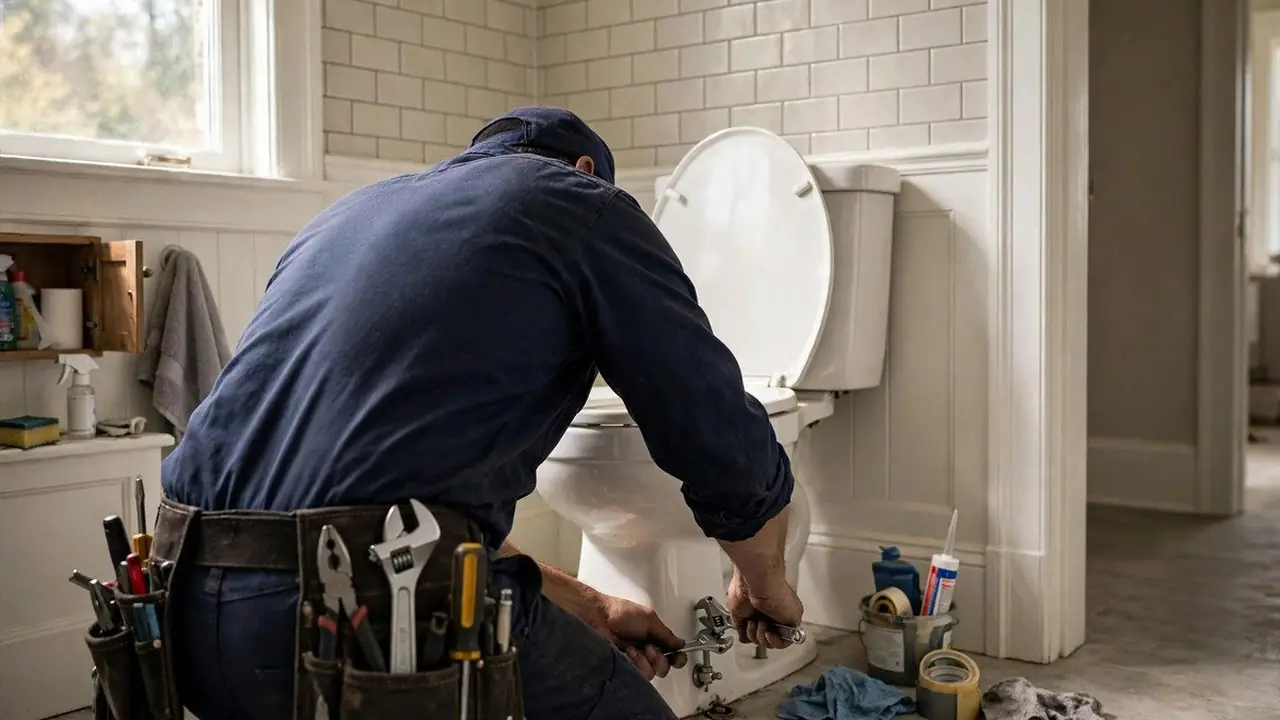
A toilet flush is gravity and a rush of water. The handle lifts a flapper, water drops from the tank into the bowl, and the bowl siphons everything down the trap. When any step fails, you get a weak flush, a slow drain or nothing at all.
Start with what you see. Does the handle move freely? Does water leave the tank? Does the bowl fill and then drain slowly, or does it stay full? Each answer points to a different cause, and most are cheap to fix.
This guide covers what to check, how to fix the common failures and when the cause is bigger than the toilet.
Match the symptom to the cause
Start here before taking anything apart.
| What happens | Likely cause | First fix |
|---|---|---|
| Handle moves but nothing happens | Broken chain or detached flapper | Reconnect or replace the chain and flapper |
| Weak flush, tank empties | Clogged rim jets or partial clog in the trap | Clear the rim holes, plunge or auger |
| Tank does not refill fully | Low water level, a stuck fill valve or a closed supply valve | Adjust the float, check the valve |
| Bowl fills, drains slowly | Clog in the trap or drain | Plunge, then use a closet auger |
| Flush works, then bowl rises again | Partial clog deeper in the line | Check other drains, see below |
Check the tank first
Lift the tank lid and flush. Watch the chain and the flapper. The chain should have a little slack, enough to let the flapper seal but not so much that it tangles. If the chain is detached or has too much slack, the flapper does not lift all the way and the bowl gets less water.
Check the water level. It should sit about an inch below the top of the overflow tube. If it sits lower, the flush has less water to work with. Adjust the float, usually a screw or a clip on the fill valve.
Look at the flapper. A warped, cracked or slimy flapper leaks and lets the tank drain between flushes. Replace it. They are inexpensive and take a few minutes.
Then the bowl and the trap
Under the rim of the bowl are small holes that feed water into the bowl as it flushes. Mineral deposits can block them and slow the flush. Clean them with a small brush or a straightened wire, working carefully so the porcelain does not scratch.
A plunger with a flange, not a flat cup, makes the best seal. Push gently first to push the air out, then pull and push firmly. If the water drops and the bowl clears, that was it. If not, a closet auger reaches into the trap without scratching.
Do not use chemical cleaner. If it fails, you are left with a bowl of caustic water that is dangerous for the plumber and for you.
When the toilet is a symptom
If the toilet clears and the shower drains slowly, or the toilet gurgles when the washing machine runs, the toilet is not the problem. The main drain is partly blocked. Stop using water and see sewer line cleaning for the options.
If a toilet needs repair more than once a year, or the bowl is cracked, replace it. See toilet repair and installation for what a replacement involves. Newer toilets use less water per flush and many flush better than older ones.
A quick test to separate tank from bowl problems
Pour a bucket of water straight into the bowl. If the bowl drains quickly, the trap and drain are fine, and the weak flush came from the tank not delivering enough water. If the bowl drains slowly or the level rises, the blockage is downstream of the toilet.
This test takes one minute and no tools. It tells you whether to spend your time on the flapper and fill valve or on the plunger and auger. Many people repair the wrong half first.
Parts worth replacing together
If you open the tank to replace one worn part, check the others. A flapper, a fill valve and a handle are all inexpensive, and they wear at similar rates. Replacing the set in one sitting avoids a second repair a few months later.
Keep the old parts until the toilet works, so you can match the new ones. Turn the supply valve off slowly and check it closes. A valve that will not shut is worth replacing too.
Signs the toilet needs more than a repair
A cracked bowl or tank, a toilet that rocks on the floor, or a stain around the base that returns after you tighten the bolts all point to a problem a flapper will not fix. The wax seal or the flange below may have failed.
Water that seeps under a toilet can soften the subfloor over time. If you see any damp flooring, stop using the toilet and call a plumber. Catching it early is far cheaper than replacing rotted boards.
Huntley note: water, scale and your tank
Huntley's water comes from deep sandstone wells and goes through five treatment plants that use cation exchange. The Village's 2023 water quality report lists sodium at 130 ppm, and the report does not publish a hardness figure. That means we cannot tell you from the report whether scale is a big problem in your house.
Check for yourself. White or yellow crust inside the tank, around the fill valve or in the rim holes is scale. If you see it, clean the rim holes and the fill valve more often. If you have a home softener, your water arrives softer than the Village supply.
For questions about the public water supply, the Village Water Division is at (847) 515-5222.
Frequently asked questions
The tank is not delivering enough water, the rim holes are clogged or there is a partial clog in the trap. Check the water level and clean the rim.
The chain or handle arm is broken or disconnected. A new handle or chain fixes it.
Yes. A worn flapper or a stuck float is usually the cause. Both are quick repairs.
Sometimes. If other fixtures drain slowly, the main drain may be partly blocked.
A like-for-like replacement is minor. For layout changes, ask Development Services at (847) 515-5252 about permits.
Still unsure what you are dealing with? Describe it to a dispatcher and get a straight answer.
Call (847) 281-8626If the cause is deeper than the tank, call. We also serve Hampshire and Gilberts, and drain cleaning is a service we do daily.
The guidelines printed in your toilet's manual list the correct water level for its model.